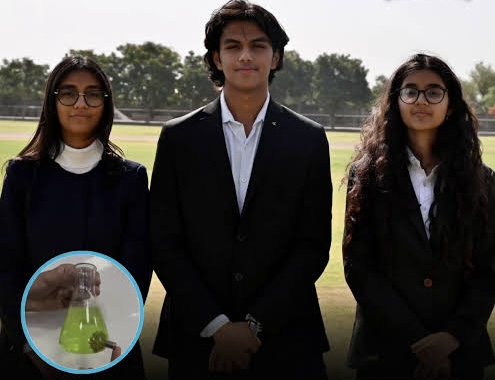
A team of Indian teenagers has taken home The Earth Prize 2026 for turning a common kitchen waste product into a powerful tool to fight water pollution.
Students Vivaan Chhawchharia, Ariana Agarwal and Avyana Mehta were recognized for creating Plas-Stick a low-cost, biodegradable filter made from tamarind seed powder that can capture microplastics from water.
Their project stood out because it addresses a problem that most conventional filters struggle with. Microplastics are so tiny they often slip through standard purification systems and end up in drinking water. The students’ solution tackles that gap without introducing any toxic chemicals into the water.
Instead of using expensive synthetic materials, the trio extracted a natural binding agent from discarded tamarind seeds. When the powder is mixed into contaminated water, it acts like a magnet for plastic particles.
“Tiny bits of plastic hide in our drinking water, but they’re too small to see. We make a special powder from thrown-away tamarind seeds that acts like a magnet for these tiny plastics,” the team explained on the official Earth Prize website.
Once the microplastics attach to the powder, they clump together. The students then use a magnet to pull the clumps out, leaving behind cleaner water.
“When mixed into a container of water, the plastics stick together into little clumps. We pull them out with a magnet, leaving cleaner water behind,” they said.
What makes the invention even more practical is what happens to the plastic afterward. Rather than letting it re-enter the environment, the collected waste is repurposed.
“The collected plastic is safely turned into small useful items like tiles or coasters so it can’t return to nature. This simple method helps protect people, animals, and our planet from invisible plastic pollution.”
The team describes Plas-Stick as both effective and affordable, with the potential to be scaled for households, schools, and communities that lack access to advanced filtration systems.
Microplastic pollution has become a growing global health concern, with particles now found in drinking water, food, and even the air. Most existing solutions are costly or energy-intensive. By using tamarind seed waste — something India produces in large quantities — the teens have proposed a method that is sustainable, scalable, and rooted in local resources.
Judges at The Earth Prize 2026 praised the project for being innovative, practical, and easy to implement in real-world settings.
With plastic Vivaan, Ariana and Avyana have shown how young minds can turn everyday waste into a climate solution — and offer hope for cleaner water worldwide.