Project was successfully completed from June 17 to July 3 2026 at Simoluguri and Merbangchuba villages
of Udalguri District of Assam.
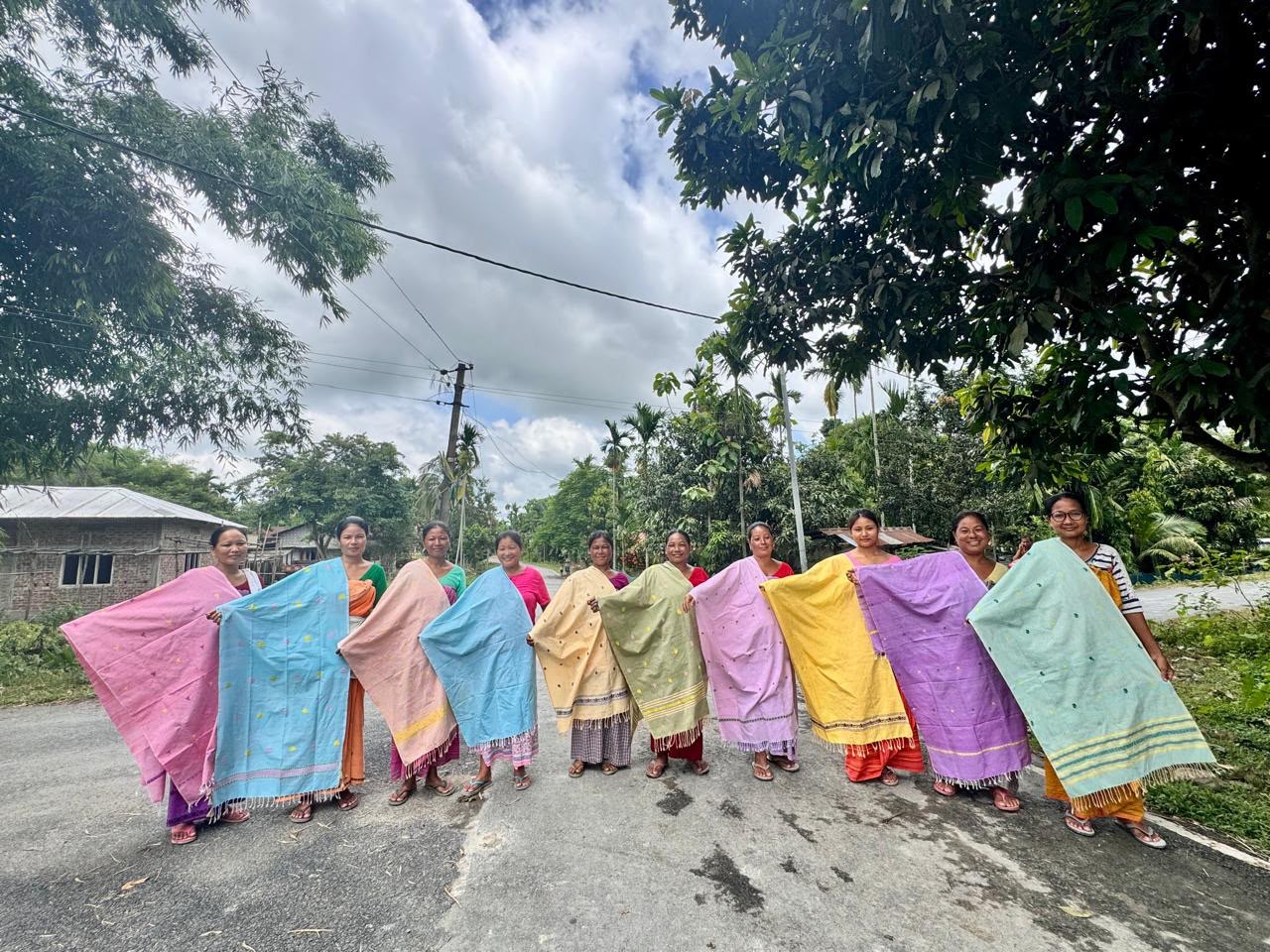
A total of 62 weavers, including 31 participants each from Simoluguri and Merbangchuba villages,
participated in the training programme. The initiative provided artisans with hands-on experience in
Jacquard machine operation, design development, pattern creation, and product diversification while
ensuring that the cultural identity of traditional weaving practices was preserved.
The 15-day programme aimed to enhance the technical skills of local artisans through advanced Jacquard
weaving techniques, encourage innovation in traditional handloom products, and strengthen sustainable
livelihood opportunities for weaving communities.
The training combined with classroom sessions with extensive practical demonstrations, enabling
participants to understand Jacquard mechanisms, punch card systems, intricate motif development,
improved weaving techniques, and quality finishing standards suitable for commercial markets.
The programme encouraged artisans to experiment with new designs, colour combinations, and innovative
product concepts. Through continuous practice and expert guidance, participants developed new Jacquard
patterns and enhanced their confidence in creating value-added handloom products with improved market
potential.
As part of the initiative, 3 kg of yarn was distributed to each of the 62 participating artisans to support
continued production after completion of the training. The yarn support will enable weavers to apply their
newly acquired skills, develop innovative products, and strengthen their handloom-based livelihood
activities.
The valedictory programme was organised at both the venues, Simoluguri Village and Merbangchuba
village, where certificates were distributed to all participating artisans in recognition of their successful
completion of the training programme and their commitment towards skill enhancement.
In the Simoluguri village, the occasion was graced by National Award-winning weaver Mrs. Kamal Das,
who delivered an inspiring and insightful address to the artisans. In her deliberation, she highlighted the
importance of preserving traditional weaving heritage while embracing innovation, improving quality, and
exploring new market opportunities. Her valuable interaction with the artisans greatly motivated the
participants.
A Scientific and Industrial Research Organisation, recognised by the DSIR, Ministry of Science and Technology, Govt. of
India,Registered under the Societies Registration Act XXI of 1860 with registration number 3096 of 1989-90
The programme was successfully guided under the leadership of Assistant Director Manas Kumar
Bhattacharjya, whose continuous supervision and coordination contributed significantly to the smooth
implementation of the training.
Dr Deba Kumar Dutta, Deputy Director, Rhino Research and Conservation Division (RRCD) of Aaranyak,
played an instrumental role in supporting and strengthening the programme. The contribution of the
technical team was also highly significant, with Ms. Anjima Daimari, Community Development Expert
(CDE), providing excellent coordination and support throughout the programme.
Nandeshwar Deha, Master Trainer, played a vital role in imparting technical knowledge and practical
training on Jacquard weaving. Arjun Hazarika, Textile Expert, and Darshana Boro, Junior Designer,
provided valuable technical guidance and design inputs that helped artisans improve their skills and develop
innovative products.
The valedictory session in Merbangsuba was also attended by officials from the Forest Department,
including Kameshwar Boro, Deputy Range Officer and Beat Officer, Paneri under Nunai Range, and Durga
Basumatary, Forester-I, Santipur Beat, who extended their encouragement and support to the participating
artisans.
Representatives from Aaranyak, including Rabiya Daimari and Abhijit Saikia, also graced the occasion and
appreciated the achievements of the trained artisans.
The successful completion of the Fourth Product Development Training Programme marks another
important milestone under the THREAD Project in Udalguri. By combining traditional weaving knowledge
with modern Jacquard technology, the programme has strengthened artisan capacity, promoted design
innovation, and created opportunities for improved product quality, market access, and sustainable
livelihood development.
The initiative is expected to contribute significantly towards the long-term economic resilience of local
weaving communities while supporting the objectives of cultural preservation, community empowerment,
and conservation-linked livelihood enhancement.