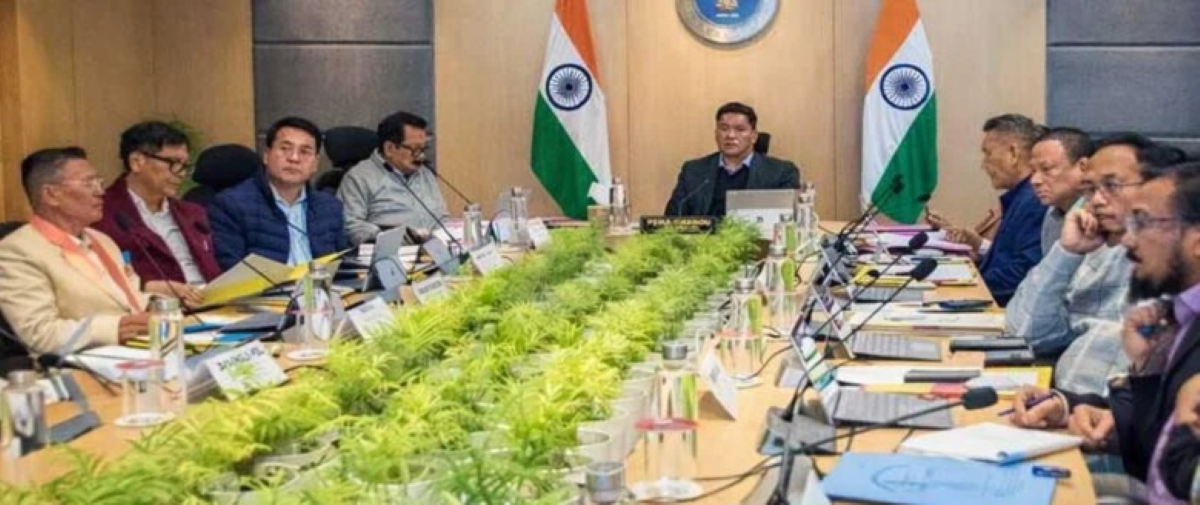
The Arunachal Pradesh Cabinet gave its nod to a series of decisions focusing on education reforms, strengthening of financial and health administration, employee welfare, and climate action, besides clearing key recruitment and pay-related proposals across departments.
The meeting , chaired by Chief Minister Pema Khandu, on Monday approved five major decisions concerning the education department, including proposals to regulate teacher transfers through legislation, grant professorship to college teachers, amend recruitment rules for principals, frame rules for Physical Education Teachers, and revise the state’s seat reservation policy for diploma and allied courses.
The Cabinet also approved the Arunachal Pradesh Transfer and Posting of Employees of Education Department (Regulation & Management) Bill, 2026, which will be placed in the ensuing Assembly session beginning March 6, an official statement said. The proposed law seeks to replace the existing policy-based transfer system with a statutory, transparent and technology-enabled mechanism linked to a fully automated Teachers’ Registry Portal.
Recruitment rules for physical education teachers under the secondary education department were also approved to ensure transparent and systematic appointments in government schools.
In higher education, the Cabinet approved granting professorship to government college teachers under the Career Advancement Scheme in line with UGC Regulations, 2018, to promote quality research and academic excellence.
It also cleared amendments to the recruitment rules for the post of principal in government colleges to align with updated UGC norms.
Moreover, the Cabinet approved the amendment of the existing reservation policy for diploma, PCM, PCB and allied seats.
The Cabinet also launched the Pakke Declaration Implementation Report-2025, reviewing progress of the Pakke Tiger Reserve 2047 Declaration on climate-resilient development adopted in November 2021. According to the report, out of 410 action lines under 75 climate-resilient strategies being implemented by 23 departments, 246 have been completed, 70 are ongoing and 94 are at the initiation stage