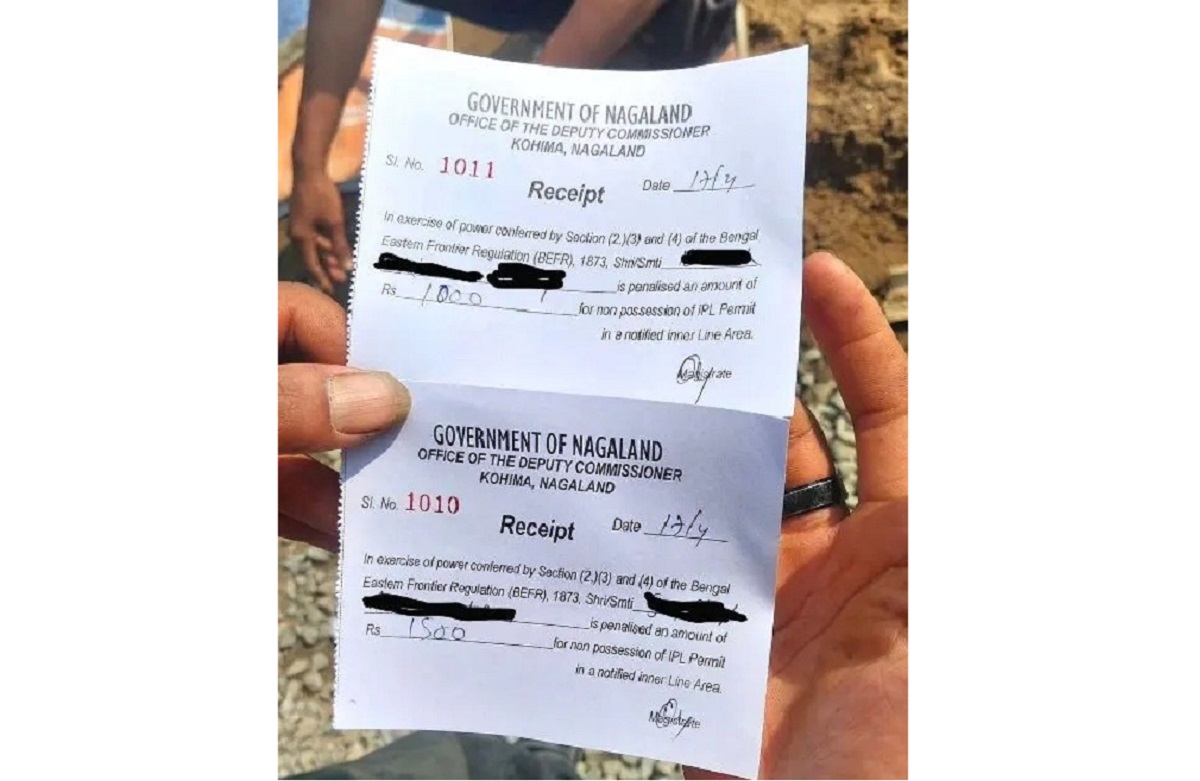
The district administration in Kohima has issued a clarification after two Inner Line Permit (ILP) fine receipts went viral on social media and created confusion among the public. According to the office of the Deputy Commissioner, the issue came to light after images of two receipts, carrying serial numbers 1010 and 1011, were widely shared online following a routine verification drive conducted on April 17. The administration said the drive was part of regular checks to ensure that individuals staying or working in the town have valid permits as required under the Bengal Eastern Frontier Regulation, 1873.Officials said several individuals were found without valid ILP documents during the drive and were fined in the presence of magistrates. Proper receipts were issued at the time, following due procedure.
However, confusion began after the receipts were shared online without full context. The administration clarified that receipt number 1010 was issued jointly to three individuals, with a total fine amount of Rs 1,500. Similarly, receipt number 1011 covered two individuals, with a combined fine of Rs 1,000. All five persons were working at a construction site near Classic Island in Kohima at the time of the inspection.The individuals fined under receipt 1010 were identified as Joy Singh (35), Arson Enghi (18), and Welson Teron (26). Those under receipt 1011 were Binush Chingthong (19) and Dilip Phangcho (20). All of them are residents of Karbi Anglong.The administration further stated that all five individuals have been asked to appear for further verification. During the inquiry, Welson Teron admitted that he had uploaded the receipts on Facebook using his personal account in Karbi language on the same day the drive was conducted.
Officials also pointed out that there was a minor printing error on the receipt coupons, which may have added to the confusion. They said the error has now been corrected and necessary steps have been taken to avoid such issues in the future.The district administration has urged people not to draw conclusions based on incomplete information and to avoid sharing unverified content. It said enforcement drives like these are routine and are carried out to maintain proper records of individuals entering and working in the state.