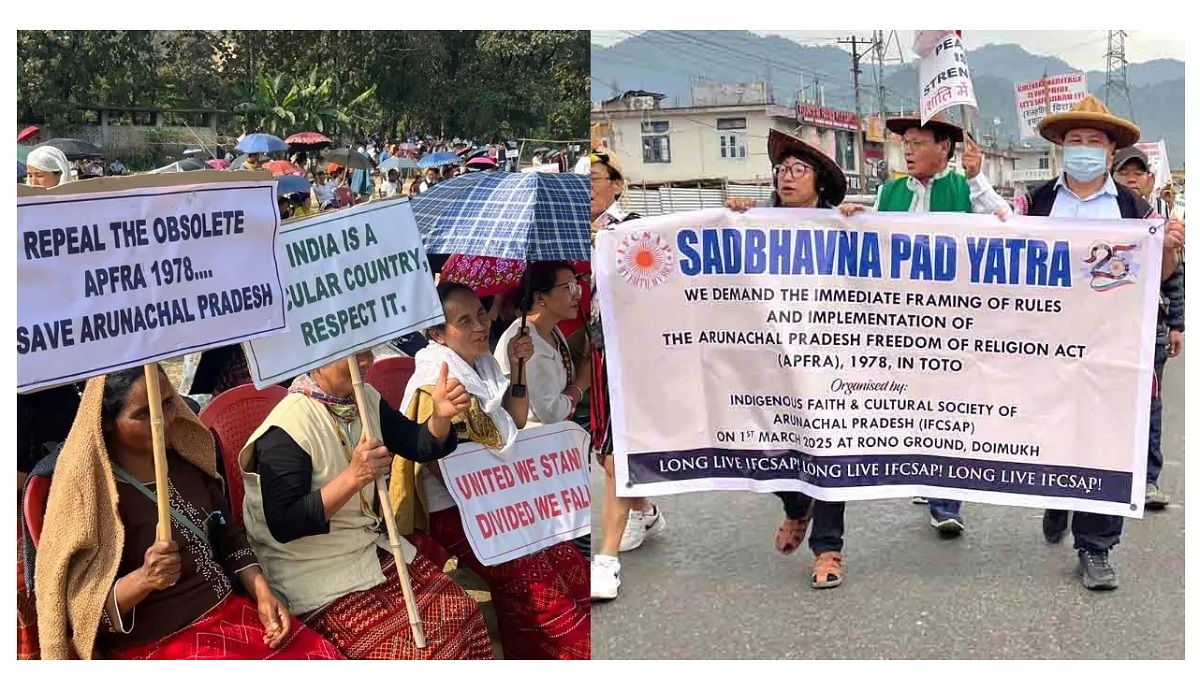
Large-scale protests were held across different parts of Arunachal Pradesh as members of the Arunachal Christian Forum and other community groups demanded the repeal of the Arunachal Pradesh Freedom of Religion Act (APFRA), 1978. Rallies, dharnas, and protest gatherings were organised in several districts including Lower Dibang Valley, West Siang, East Kameng, Kamle, and other areas of the state. Protesters gathered in both urban centres and rural regions carrying banners and placards while raising slogans against the law. In Itanagar, a large number of people assembled to express opposition to the decades-old legislation, which many protesters claimed restricts religious freedom and targets the Christian community. Addressing protesters during a rally in the state capital, ACF president James Techi Tara said the demand for repeal of the Act had continued for decades without resolution. He said members of the Christian community believed that the law violated constitutional rights related to freedom of religion and freedom of belief in a democratic country. According to him, several rounds of discussions had already taken place between representatives of the organisation and the state government, but no concrete outcome had emerged so far. Protesters at different demonstration sites said the movement would continue peacefully until the government took steps to repeal the legislation.Participants described the protests as democratic and peaceful demonstrations aimed at drawing attention to what they called a long-pending issue affecting religious freedom in the state.
Many speakers at the gatherings said concerns had increased in recent years following discussions surrounding the framing and implementation of rules under the Act.The Arunachal Pradesh Freedom of Religion Act was passed in 1978 with the stated aim of preventing religious conversions through force, inducement, or coercion. However, the law has remained controversial for many years, especially among Christian organisations and religious groups that argue the legislation is outdated and vulnerable to misuse. Although the Act was passed decades ago, rules for its implementation were reportedly not framed for a long period, which kept the law largely inactive for years. In recent times, renewed discussions regarding possible implementation of the Act brought the issue back into public debate and triggered fresh protests from Christian groups and civil society organisations. Many organisations opposing the law have argued that such legislation goes against constitutional guarantees related to individual freedom and secular values. At the same time, supporters of the law in the past have maintained that it was designed to prevent forced or manipulated religious conversions and protect indigenous communities. The issue has remained politically and socially sensitive in Arunachal Pradesh because of the state’s diverse tribal and religious composition. The state government has held consultations with different religious bodies, community organisations, and stakeholders regarding the matter, but no final consensus has been reached. In East Siang district, the East Siang Christian Forum organised a peaceful dharna at Pasighat where hundreds of people reportedly gathered to protest against the framing of rules under the Act.
During the programme, speakers discussed the history of the legislation and expressed concern over attempts to revive provisions of a law enacted nearly five decades ago. Religious leaders and community representatives who addressed the gathering said they believed the implementation of the law could affect constitutional freedoms and religious rights. The programme in Pasighat included speeches, prayer sessions, and discussions focused on unity among community members and continuation of peaceful democratic protests. The first session of the programme was chaired by ESCF president Takeng Samior. Religious leaders including Rev John S. Borang and other speakers also addressed the gathering. Another session focused on community solidarity and concluded with a mass prayer attended by participants. Meanwhile, protesters in different districts said they would continue raising the issue until the government takes a clear decision on the future of the Act.