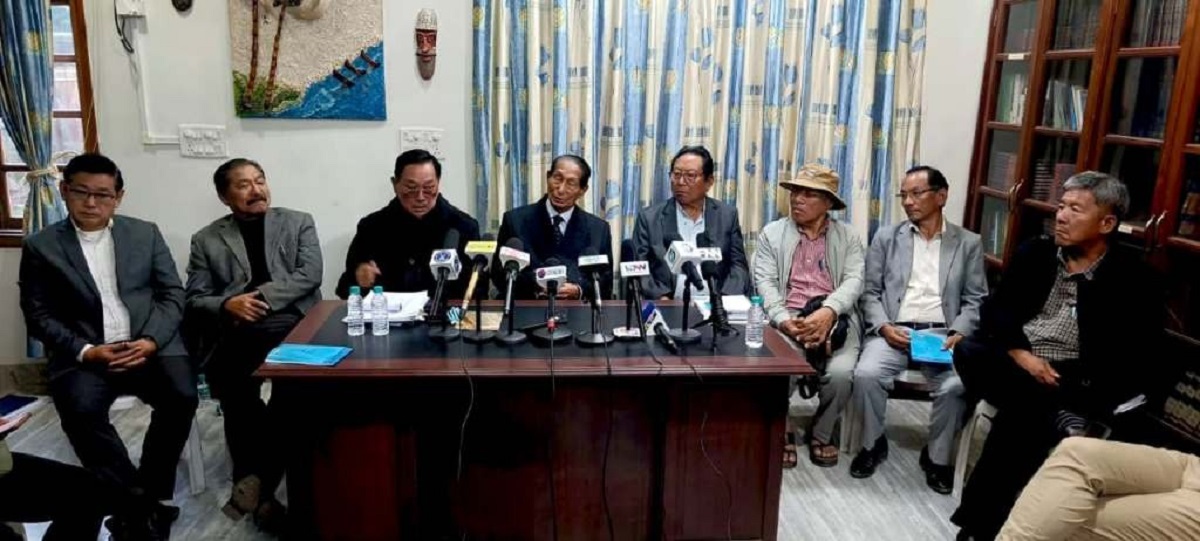
A group of 24 senior leaders from various professions in Nagaland has emphasized the urgent need for the implementation of the Naga political agreements concluded between the Government of India and Naga political groups, citing prolonged delays that have caused growing uncertainty and hardship in the state. The assembly, which included former legislators, ministers, and intellectuals, took place at the residence of prominent Naga leader Dr. S.C. Jamir, a former Chief Minister and Governor, where they later hosted a press conference.
Dr. Jamir characterized Nagaland as being in a state of distress, likening it to “a wounded person groaning in pain,” and stressed that a political resolution should have followed the signing of the Framework Agreement with NSCN (I-M) in August 2015 and the subsequent Agreed Position with WC/NNPGs in November 2017, after extensive negotiations. He pointed to the delays in implementation as a “deliberate” action by NSCN (I-M), despite commitments from other Naga Political Groups. Dr. Jamir recalled the celebratory atmosphere during the signing ceremony, attended by high-ranking government officials, and questioned the rationale for further postponements, asserting that swift implementation is essential for the Naga people to achieve peace and progress akin to other states.
Reiterating that the contents of the agreements do not involve sovereignty or integration, Dr. Jamir maintained that not every clause requires constitutional endorsement, referring to past agreements where only critical aspects were included in the Constitution. He clarified that NGOs and civil organizations are not parties to these agreements and, therefore, cannot seek additional provisions beyond what has been established.
Convener K. Therie highlighted the ongoing challenges faced by the Naga populace, particularly the educated unemployed youth, who are suffering due to the lack of a final resolution. He urged the Government of India to take action on the agreements and called for the Nagaland Joint Christian Forum (NJCF) to assist in safeguarding the state’s future. Therie emphasized the apolitical nature of their forum and invited other like-minded individuals to join. He also encouraged the youth to take initiative in shaping their futures and confirmed elder support.
On the matter of the Pan Naga Hoho, Therie noted widespread opposition from various organizations, asserting that the Centre cannot enforce it without adequate consultation and inquired why Nagas from outside Nagaland should obstruct a solution tailored for the state. He clarified that concerns over the flag and sovereignty have not properly represented the central issues at hand.
Former Legislative Assembly Speaker Z. Lohe criticized the Government of India for failing to deliver an anticipated political solution, expressing that the delay primarily stems from NSCN (I-M). He questioned the significance of agreements if they were not being honored.
Retired commissioner K.K. Sema emphasized the urgent needs of the educated unemployed youth, insisting that the resolution should cater to both the older and younger generations. He accused the state government of stalling progress and labeled its Political Affairs Committee as a mere “political gimmick.” Sema argued that the negotiating groups should communicate their demands clearly to the public and asserted that if NSCN (I-M) wishes to keep competency clauses, these should apply elsewhere, not in Nagaland.
The assembly concluded by resolving to advocate for the prompt implementation of the agreements to both the Centre, the state government, and the Ceasefire Monitoring Group (CFMG), with further consultations planned to maintain momentum in this dialogue.